Tuesday, 29 April 2014

Methods of Heat Setting

Heat Setting:
Heat setting is a heat treatment by which shape retention, crease resistance, resilience and elasticity are imparted to the fibres. It also brings changes in strength, stretchability, softness, dyeability and sometimes on the colour of the material. All these changes are connected with the structural and chemical modifications occuring in the fibre. Normally heat setting done for lycra fabric.

Methods of Heat Setting:

Contact method
In this method the fabric is run in contact with a heated metal surface. Some machines are composed of metal rollers having gas fired cores and are filled with a liquid known as diatherm to uniformly distribute the heat. Sometimes enclosed rollers are heated with high temperature steam.

Steam-setting method
Short staple polyester yarns including polyester/cotton blends are normally set by relaxation in saturated steam. The most effective means of stabilising these materials are to steam at 107~ on the ring spinners tube and soft dyeing packages under minimum tension. Sewing threads receive special setting treatments, designed to confer stability whilst preserving their high tensile properties. Polyester garments, garment lengths and hosiery are also stabilised by steaming in much the same way as for yams. Nylon can be set in saturated steam at temperatures above 1OO°C in an autoclave by batchwise process.

Hydro-setting method
The hydro-setting or aqueous heat-setting of polyester is done with hot water in a high temperature liquor circulating machine at about 130°C. A typical cycle may require 30 min. Water (or steam) promote swelling of fibre and may cause some hydrolysis in the ester groups in polyester chain. Nylon fabric can be hydro-set in hot water since the swelling action assists in weakening or breaking intermolecular bonds.

Heat-setting using stenter frame
Stenter machine are widely used for stretching, drying, heat-setting and finishing of fabrics (Fig). Woven and knitted fabrics of polyester and nylon fibres and their blends are normally heat-set on pin-stenter in hot air. 
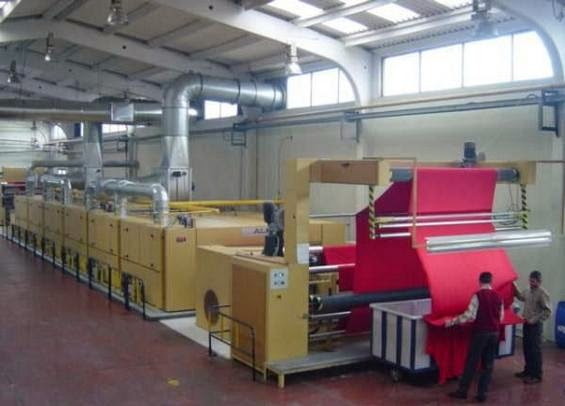
Figure. Stenter for drying, finishing and heat-setting knitted and woven fabrics
An alternative to the pin stenter is the clip machine. The fabric is held into the chains either by pins mounted into a base plate or by clips in which the fabric edge is clamped between two smooth surfaces. Stenters that are used for setting only have a light pin chains whereas stenters used for both drying and setting (finishing) are provided with a heavy combined pin and clip chain.

Selective infra-red emitters method
Polyester can be heat-set by exposing the material under selected areas of magnetic spectrum of infra-red rays. The wavelength of the radiation source must be chosen with respect to the absorption band of the fibre i.e. a particular infra-red wavelength is chosen for a particular fibre. For example, in the case of polyester the selective infra-red radiation wavelength is the region of 1 to 4 g.

Monday, 28 April 2014

Geotextile: Soil Improvement Techniques

SOIL IMPROVEMENT TECHNIQUE
Kamble Zunjarrao B.
D.K.T.E.S. Textile & Engineering Institute
Ichalkaranji, India
Email: kamblezunjar@gmail.com


ABSTRACT:
Soil alone is strong enough in compression but comparatively weak in tension. Reinforcing soil is the technique where tensile elements are placed in the soil to improve stability and control deformation. The geotextiles are used as reinforcement, their prime role is to provide tensile strength to soil at strain level which is compatible with the performance of the soil structure. Textiles are used as reinforcement in the form of fibers, fabric form like woven, knitted, non wovens. Geosynthetics are used as reinforcement in paved roads, in railway tracks, embankment of shallow weak soils, earth retaining walls, mining subsidence protection etc. This papers deals with the different types of geosynthetics which are majorly used in reinforecement of soil, so that the soil gets stabilized and the problems like erosion can be controlled.

KEYWORDS: Geosynthetics, tensile reinforcement, non-woven geotextiles, surface reinforcement.

Introduction
The first auther to advocate the concept of reinforced soil was probably C .W. Pasley in 1822. The technique of reinforcing soil in its modern form was first developed by M. Henri Vidal & who named his system as ‘Reinforced Earth’. The soil is strong in compression & weak in tension, and therefore to provide tensile strength to soil, the reinforcement of soil is necessary. The three main areas where soil reinforcement may be applied are as follow: slope & embankments, foundations, retaining walls. The introduction of geomaterials with higher strength & higher tensile stiffness make novel solution for geotechnical problems.

Now, we should first understand what are the geotextiles, their types & then their actual practical application & implementation. The geotextiles are defined as permeable textiles used in conjunction with soil or rock, as an integral part of manmade projects. Every textile applied under the soil is a geotextile. Geotextiles are functioning as separator, filter, drainage material, reinforcement, sealing & protection. Depending upon the required function, they are used in open mesh form, woven form, non-woven form & knitted form. The geotextiles are broadly classified into two categories as biodegardable & non-biodegradable. The geotextiles which are non- biodegradable are also named as geosynthetics as their basic raw material is manufactured from petroleum products.

Different Categories of Geosynthetics:
  1. Geotextiles- These are flexible textile fabrics of controlled permeability used to provide filtration, separation or reinforcement in soil, rock and waste material.
  2. Geomembranes- These are impermeable polymeric sheets used as carrier for liquid or solid waste containment.
  3. Geogrids- Stiff or flexible polymer grid like sheets with large aperture used primarily as reinforcement of unusable soil and waste masses.
  4. Geonets- stiff polymer net like sheets with in plane opening used primarily as a drainage materials within landfills or soil and rock masses.
  5. Geosynthetic clay liners- prefabricated bentonite clay layers incorporated between geotextile and geomembrane and used as a barrier for liquid or solid waste containment.
  6. Geopipes- Perforated or solid wall polymeric pipes used for the drainage of various liquids.
  7. Geocomposites- Hybrid systems of anyor all the above geosynthetics types which can function as specifically designed for use in soil,rock, waste and liquid related problems.
  8. Geofoam- A newer category of product is geofoam. Which is the generic name for any foam material utilized for geotechnical application. Geofoam is manufactured into large blocks which are stacked to form a light weight thermally insulating mass buried within a soil or pavement structure.
Fig. Geocell
Different Types of Geotextiles:
Woven geotextiles – Woven geotextiles are manufactured from by adopting technique similar to clothing textiles. This type has characteristic appearance of two stes of parallel threads or yarns.They have a surprisingly wide range of applications and they are used in lighter weight form as soil separators, filters and erosion control textiles. In heavy weights, they are used for soil reinforcement in steep embankments and vertical soil walls; the heavier weight products also tend to be used for the support of embankments built over soft soils. The beneficial property of the woven structure in terms of reinforcement, is that stress can be absorbed by the warp and weft yarns and hence by fibres, without much mechanical elongation. This gives them a relatively high modulus or stiffness.

Non-woven geotextiles – Non-woven geotextiles can be manufactured from either short staple fibres or continuos filaments. The fibers can be bonded together by adopting thermal, chemical or mechanical techniques or a combination of techniques. The type of fibre (staple or continuous) used has very little effect on the properties of the non – woven geo synthetics. Non-woven geotextiles are manufactured through a process of mechanical interlocking or chemical or thermal bonding of fibres/filaments.

Knitted geotextiles – knitted geosynthetics are manufactured using another process which is adopted from clothing textiles industry. In this process, interlocking a series of loops of yarn together is made. The majority of knitted geosynthetics made from polypropylene & polyester fibres. Knitted fabrics, as used in the field of geotextiles, are restricted to warp-knitted textiles, generally specially produced for the purpose.Warp-knitting machines can produce fine filter fabrics,medium meshes and large diameter soil reinforcing grids. However, it is generally found that only the high strength end of the product range is cost effective, usually for soil reinforcement and embankment support functions.
Fig.woven geotextile structure    Fig.non woven geotextile structure   Fig. Knitted geotextile structure
How geotextile functions as reinforcement in soil:
Load on the soil produces expansion. Thus, under load at the interface between the soil and reinforcement (assuming no slippage occurs, i.e. there is sufficient shear strength at the soil/fabric interface). These two materials must experience the same extension, producing a tensile load in each of the reinforcing elements that in turn is redistributed in the soil as an internal confining stress. Thus the reinforcement acts to prevent lateral movement because of the lateral shear stress developed. Hence, there is an inbuilt additional lateral confining stress that prevents displacement. This method of reinforcing the soil can be extended to slopes and embankment stabilisation.

Strength created by the introduction of geotextile into the soil & developed primarily through the following three mechanisms-
  1. Lateral restraint through interfacial friction between geotextile and soil/aggregate.
  2. Forcing the potential bearing surface failure plane to develop at alternate higher shear strength surface.
  3. Membrane type of support of the wheel load
The structural stability of the soil is greatly improved by the tensile strength of the geosynthetic material. This concept is similar to that of reinforcing steel to the concrete. Since concrete is weak in strength & tension, reinforcing steel is used to strengthen it. Geotextile materials function in a similar manner as the reinforcing steel by providing strength that helps to hold the soil in place. Reinforcement provided by the geotextiles and geogrids allow embankment & roads to be built over very weak soils & allows for steeper embankments to be built.

Steep faced embankment reinforcement using geosynthetics:
To construct a very steep slope at an angle at an inclination of 75 0 or more to the horizontal, then the structure would be more akin to an inclined retaining wall. The stress concentration beneath the steep faced embankment usually precludes their use over soft deposite. With reinforced embankment slope above or near to the natural angle of repose of the fill careful thought must be given to the surface finish. If the geotextile grid with an aperture size greater than the diameter of the fill particles is used, then the geptextile filer sheet should also be palced behind the reinforcemment grid at slope face. Usually the face will be covered with top soil & seeded. The wrap-around method envolve folding the geotextile over the exposed slope edge upto the underside of the next reinforcement layer as per the required angle & then anchoring the free end by burial within the fill.

The Tabing-Duku project near the town of Padang of the Indonesian is-lands, Sumatra, required an existing road from the airport to the city center to be widened at the most cost-efficient price possible. In spite of extremely problematic ground conditions on the site with low load-bearing capacities and a high ground-water level. The solution involved an embankment reinforced with uniaxial Secugrid® R geogrid. The reinforced slope had an inclination of more than 50° and was constructed with the wrap-around method. The slope surface was finally covered by natural vegetation.
Fig. Reinforced slope during construction                    Fig. Finished Project
Geotextile are also used for better compaction of the fill. This application is particularly well established for railway embankment in japan. As railway embankments are relatively narrow incomparison with highway embankment, it follows that greater proportion of the embankment will suffer from impaired compaction in the case of railway embankment. The climatic & seismic conditions in the japan make poorly compacted embankments faces susceptible to surface movement & erosion. On the uestu railway in japan, it was found that the presence of geogrid within the embankment enhanced both the degree of compaction & stiffness of the soil.
Fig. Collapsed railway embankment after flooding      Fig. Geogrid-reinforced railway embankment
Column supported embankments(CSEs) reinforcement with geosynthetics:
The problem associated with constructing highway embankments over soft compressible soil have led to the development and use of many ground improvement techniques. CSEs consists of vertical column that are designed to transfer the load of the embankment through the soft compressible soil layer to a firm foundation. The selection and type of column used for the CSEs will depends on the design loads, constructability of the column, cost, etc. the load from the embankment must be effectively treansferred to the column to prevent punching of the column through the embankment fill which causes differential settlement at the surface if the embankment. If the columns are placed relatively close together, soil arching will occur and the load will be transferred to the columns. Some battered columns are required at the sides of the embankment to prevent lateral spreading. In order to minimize the number of columns required to support the embankment and to increase the efficiency of the design, a geosynthetically reinforced load transfer platform(LTP) may be used. The LTP consists of one or more layers of geosynthetic reinforcement placed between the top of the columns and the bottom of the embankment. The first application of a CSE with geosynthetic reinforcement in the USA was in 1994 for the westway terminal in philadelphia, pennsylvania.

Subgrade stabilization & base reinforcement using geotextiles in roads:
A large variety of detrimental factors affect the service life of roads and pavements including environmental factors, subgrade conditions, traffic loading, utility cuts, road widenings, and aging. The four main applications for geosynthetics in roads are subgrade separation and stabilization, base reinforcement, overlay stress absorption and overlay reinforcement. Subgrade stabilization and base reinforcement involve improving the road structure as it is constructed by inserting an appropriate geosynthetic layer. Subgrade separation and stabilization applies geosynthetics to both unpaved and paved roads. Base reinforcement is the use of geosynthetics to improve the structure of a paved road.

Permanent roads carry larger traffic volumes and typically have asphalt or portland cement concrete surfacing over a base layer of aggregate. The combined surface and base layers act together to support and distribute traffic loading to the subgrade. Problems are usually encountered when the subgrade consists of soft clays, silts and organic soils. This type of subgrade is often water sensitive and, when wet, unable to adequately support traffic loads. If unimproved, the subgrade will mix with the road base aggregate – degrading the road structure - whenever the subgrade gets wet. The geotextiles used for reinforcement of road can be natural or synthetic. The natural geotextile e.g. jute geotxtiles, whereas the synthetic includes synthetic geotextiles geogrids, geonet, Geosynthetic clay liners etc.

In paved roads, lateral restraint called confinement is considered to be the primary function of the geosynthetic. With the addition of an appropriate geosynthetic, the Soil-Geosynthetic- Aggregate (SGA) system gains stiffness. The stiffened SGA system is better able to provide the following structural benefits:
  1. Preventing lateral spreading of the base.
  2. Increasing confinement and thus stiffness of the base.
  3. Improving vertical stress distribution on the subgrade.
  4. Reducing shear stress in the subgrade.
Fig. Load Spreading Phenomenon of Sub-base on Sub Grade
Application of geotextiles for roads in Ichalkaranji:
This was the first project in 1990, when geotextiles are used in india. The problem was deterioration of road frequently. Woven geotextiles were used in road & the problem was reduced to a great extent. To check the efficacy of geotextile, the geotextile was excavated after 10 years. Test results showed that there is no significant change in strength inmachine direction, proving that the geotextiles can be a long time solution for problem of the road.

(Table - The properties of geotextile used)
Particulars
Before burial
After burial
Mass per unit area, GSM
225
440
Thickness, mm
2.38
1.20
Breaking strength(KN/m)      MD
4.12
4.94
                                                CD
14.88
7.74
 
Application of geosynthetics in rail track stabilization:
Geosynthetics have been used in various ways in new rail tracks and track rehabilitation for almost three decades. When appropriately designed and installed, geosynthetics provide a cost-effective alternative to more traditional techniques. There are several problems required to be corrected in railway tracks, increasing the bearing capacity of the subgrade soil, preventing contamination of the ballast by subgrade fines, and dissipating the high pore water pressures built up by cyclic train loading. The woven fabrics or non-wovens are used to separate the soil from the sub-soil without impeding the ground water circulation where ground is unstable. Enveloping individual layers with fabric prevents the material wandering off sideways due to shocks and vibrations from running trains.

Maintaining track bed geometry is critical for efficient railroad operation. Subgrade pumping into the overlying ballast can create an uneven track bed, resulting in delayed arrivals and even derailments. Geotextiles perform multiple functions in railroad applications. Nonwoven fabrics are used to stabilize both new and rehabilitated tracks. They prevent contamination of new ballast with underlying fine-grained soils and provide a mechanism for lateral water drainage. Using nonwoven geotextiles beneath track beds ensures that the ballast can sustain the loads for which it was designed. These geotextiles are used in all track applications, including switches, turnouts and grade crossings. High-strength woven geotextiles can also be used to reinforce weak subgrade soils and reduce required embankment fill materials.
Fig. Placement of gextextile under railway track.
Discussed the physical and mechanical properties of ballast that affect the performance of railtracks. The results of cyclic tests on ballast, based on large-scale cylindrical triaxial testing, indicate that the ballast particle size distribution has a significant influence on ballast degradation,with the uniformly graded distribution being the most prone to breakage. The findings of this study suggest that the deformations of fresh and recycled ballast vary non-linearly with the number of load cycles. Irrespective of the type of ballast, reinforcement and saturation,the settlement of ballast stabilizes within about100000 loadcycles. The experimental results of this study clearly showed that with the insertion of any type of selected geosynthetics the extent of degradation and settlement in fresh and recycled ballast were reduced. It is also recommended that a bonded geosynthetics be employed because of the need to prevent the ingress of liquefied mud into ballast voids under cyclic loads, and to maintain an efficient pore pressure dissipation layer. The effectiveness of geosynthetics in improving fresh ballast behavior (deformation and degradation) was marginal, whereas it was more evident when used with recycled ballast in wet or dry conditions. According to the results, the inclusion of geocomposites in recycled ballast reduces the breakage index almost to that of fresh ballast(without geosynthetics). Hence the use of recycled ballast stabilized with geosynthetics would be a cost-effective and environmentally attractive option. The ballast and its engineering behavior have a key role in governing the stability and performance of railway tracks. The deformation and degradation behavior of ballast under static and dynamic loads was studied based on large-scale triaxial testing. The possible use of different types of geosynthetics to improve the performance of fresh and recycled ballast was also investigated .

Soil reinforcement for Rainfall erosion control:
On steep ground with little or no covering of vegetation, rainfall erosion can be a major problem. Erosion-susceptible slopes may occur naturally, for instance where vegetation is unable to become established because of poor or very thin topsoil, or where vegetation is suddenly removed by a forest fire.
Vegetative cover
Annual soil loss (tonnes/ hectare)
Forest
0.01
Grass
0.04
Crops
40
None
240
 
Table showing Relationship between soil erosion & ground cover.

The geotextile based methods of limiting rainfall erosion by stabilizing the soil can generally be devide into two categories- A. Surface cover geotextiles, B. Surface reinforcement geotextiles.

A. Surface cover geotextiles:
The surface cover geotextiles are providing temporary cover over the soil surface which dissipates the raindrop impact energy in a similar manner to foliage. Erosion control geotextiles currently available are in two different forms:

1. Paper strips held together by a knitted polymer yarn .They are placed over the ground surface after seeding and should ideally decompose sufficiently for the seedlings to push through shortly after germination. The paper strip geotextile sheet is normally anchored at the top of the slope by burial in a trench.

2. Woodwool sandwiched between two layers of polymer net.The woodwool geotextile are consists of shredded pine wood and have a weight of about 0.5 kg/m2. The outer netting is often made from 0.2mm diameter polypropylene yarn with a typical aperture size of about 35*25 mm. The greater selfweight of the woodwool geotextile and the interlocking action of plant shoots growing into the tangled woodwool also make it less vulnerable to being pushed up by seedlings. As well as protection against raindrop impact, woodwool geotextiles act as a thick blanket with many of the attributes of a conventional mulch, namely:
  • Limiting the speed of any rainfall run-off.
  • Reducing the evaporation from the soil.
  • Protecting germinating seeds from extremes in temperature. There geotextiles also provide protection against wind erosion, making then suitable for coastal same dunes.
B. Surface reinforcement geotextiles-
Surface reinforcement geotextilesfunctions in a similar manner to plant roots by reinforcing the soil surface & holding the soil particles together. Unlike surface cover geotextiles, geotextile mats are seeded after the geotextile has been laid. Another difference is that the sheet of geotextile mats are usually unrolled shallow slow, rather than laid parallel to the ground contours. After the geotextile mat has been secured on the ground surface, seed(usually grass) is sown through the mat & mixture of topsoil & seed then brushed over the mat to completely feel it. The celluler geotextiles are used for reinforcing the topsoil layer. The cellular geotextile is formed from a mechanically bonded nonwoven products which has been partially impregnated with resin in order to give it slight rigidity.

The four main sub-divisions of surface reinforcement geotextiles are:
  1. Thick three dimensional mats
  2. Cellular geotextiles
  3. Geotextileswoven from thick, widely spaced yarns
  4. High profile geotextiles nets.
Geo textiles for reinforcement of retaining walls:
Retaining walls help to maximize their land use. However, building a concrete gravity or crib wall is often impractical because of their high construction cost. Geotextiles are used for a wide assortment of reinforcement applications, including embankments over soft soils, levees and retaining walls. Geotextiles are well-suited to construction of walls with timber, precast panel and segmental block facing. In fact a geotextile retaining wall can be built for less than half the cost of a conventional wall. Woven geotextiles offer other significant advantages over conventional methods, such as simplified installation and construction, and the ability to use on-site backfill material. Polypropylene geotextiles cost approximately half the amount of polyester and polyethylene geogrids, and they require considerably less labor to install.

Geotextiles for Sports field construction & reinfocrement:
Geotextiles are widely used in the construction of Caselon playing fields and Astro turf. Caselon playing fields are synthetic grass surfaces constructed of light resistance polypropylene material with porous or nonporous carboxylated latex backing pile as high as 2.0 to 2.5 cm. Astro Turf is a synthetic turf sport surface made of nylon 6,6 pile fibre knitted into a backing of polyester yarn which provides high strength and dimensional stability. The nylon ribbon used for this is of 55 Tex. It is claimed that the surface can be used for 10 hr/day for about 10 years or more. Modern Astro Turf contains polypropylene as the base material.

Hockey field in Hamilton, New Zealand was stabilized using geotextiles. Nonwoven geotextile was used as a solution to separate weak pumping subgrade and clean gravel base. The actual subgrade CBR achieved on site was seven. Nonwoven geotextile was laid on the subgrade which enabled the subbase and base course to remain clean and maintain its strength, with the primary function to allow water to pass quickly and lower pore pressure build up in the subgrade.
Fig. Reinforced retaining wall              Fig. Hockey field, Hamilton, New Zealand
Conclusion:
Textiles are not only clothing the human body but also our mother land in order to protect her. The structural stability of the soil is greatly improved by the tensile strength of the geosynthetic material. Geotextiles like geonets, geogrids, geocomposites are functioning as separator, filter, drainage material, reinforcement, sealing & protection. The reinforcement acts to prevent lateral movement because of the lateral shear stress developed. Reinforcement provided by the geotextiles and geogrids allow embankment & roads to be built over very weak soils & allows for steeper embankments to be built. Therefore the geotextiles are applied in paved roads, rail road embankment stabilization, erosion control, sport field construction.

References:
  1. Geosynthetics in civil engineering, edited by R.W.Sarsby.
  2. Advances in Geosynthetics Materials and Applications for Soil Reinforcement and Environmental Protection Works.Ennio M. Palmeira.
  3. Handbook of technical textiles, edited by S.C. Anand.
  4. Georg Heerten, “Improving the Bearing Capacity of soils with Geosynthetics” improvement of soil properties, Bratislava June 2007 P. No. 4-5.
  5. B. indraratna “geotechnical properties of ballast and the role of geosynthetics in rail track stabilization” Ground improvement Oct. 2006, No.3, P. No. 91-101.
  6. Handbook of Geosynthetics.
  7. Kousik deb “Design of geosynthetic-reinforced earth using equivalent thickness concept” Indian Journal of geosynthetics January 2013 Vol. 2 No.1, P.No.4-8.
  8. B. indraratna “The role of geosynthetics in rail track stabilization” Ground improvement Oct. 2006, No. 3, P. No. 91-101.
  9. Ennio M. Palmeira “Advances in geosynthetics materials and applications for soil reinforcement and environmental protection works”.
  10. Geotextiles by John N.W.M.
  11. ‘Design of Coastal Revetments,Seawalls, and Bulkheads’, engineer manual.
  12. Shanmukhi Gupta, P.S. Rawat, ‘Application of Geosynthetics in coffer dam: A Case Study’,KDCDE, Hydro Engg. DGM, Hydro Engg.NTPC Ltd.
  13. Ennio M. Palmeira, fumio tatsuoka, ‘Advances in Geosynthetics Materials and Applications for Soil Reinforcement and Environmental Protection Works’,
  14. K. Renken, D.M. Mchaina, E.K. Yanful, ‘Geosynthetics research and applications in the mining & mineral processing environment’, Civil & environmental engineering, university of western ontario, london.
  15. Jack Fowler,’ Dewatering sewage sludge with geotextiles tubes’, GEOTEC Associates.
  16. Permathene earth solutions brouchure.
  17. www.fiber2fashion.com
  18. www.mirafi.com
  19. www.scribd.com
  20. www.technicaltextiles.net
  21. www.gmanow.com 
 

Sunday, 27 April 2014

Career Prospects of Textiles Industry in Bangladesh

Career Prospects of Textiles Industry in Bangladesh

Rahamat Ullah Joy
B.sc in Textile Engineering
Daffodil International University
Email: rahamat.tex@gamil.com
Phone: +8801614445257 


Abstract:
A career is a sequence of positions held by a person during the course of a lifetime. Lifelong, self-monitored process of career planning that involves choosing and setting personal goals, and formulating strategies for achieving them. You can also read Job opportunity of textile engineers in Bangladesh. 

Career:
A career stands for all the roles you play throughout your life - education, training, paid and unpaid work, family, volunteer work, and leisure activities and so on.
"Career" was traditionally associated with paid employment and referred to a single occupation. In today’s world the term career is seen as a continuous process of learning and development. Activities that contribute to a career can include:
  1. Training
  2. Education
  3. Employment
  4. Work experience
  5. Community activities
  6. Enterprise activities
  7. Employment
  8. Different life roles
  9. Volunteer work
  10. Leisure activities and
  11. Research
Making the best career selects involves:
  • Knowing thyself - what you like (your passion), what you are good at (your skills and abilities), what is important to you (values)
  • Getting to understand the present world of work - what’s out there?
  • Learn how to make innovative decisions
  • Finding out how to achieve objectives or goal
Textile Engineers Career in Bangladesh:
No doubt those who are textile engineer he/she can involved or admitted as a textile engineer in a textile industry without hesitation because he/she know all about textile related topic so he/she can manage that situation. I can say that the textile engineer’s carrier is brighter than other engineers in Bangladesh.

Textile Engineer’s Job: 
Bangladesh is the RMG leading country in the world so there is a reason that is there are more than 8000(Eight thousand in locally and internationally) and there are more than 5 million people are worked. So we can say that there are huge job scopes of textile engineers.

Category of Job:
There are different category of job in textile industry and clothing industry in Bangladesh. Such as:
  1. Planning
  2. Procurements
  3. Developed of plan
  4. Inventory
  5. Inspection
  6. Implement
  7. Management
  8. Supervising
  9. Production
  10. Lining
  11. Quality control
  12. Quality Inspection
  13. Statistical Quality Control
  14. Quality assurance
  15. Merchandising
  16. Commercial and
  17. And so on
Another category
  1. Government and others
  2. Government (Special)
  3. And some Special Job
1. Government and others:
  • BJMC
  • BJRI
  • BSTI
  • IJSC
  • BGMEA
  • BKMEA
  • FBCCI
  • EPB
  • BEPZA
  • EPZ
  • DOT
  • MOT
  • BTEB
  • BTMC
2. Government Job (Special):
  • DOT (Assistant Director)
  • Instructor (Technical)
  • Instructor (Vocational)
  • Superintend (Vocational)
  • University (Public)
  • University(Private)
  • College (Textile)
  • Textile Institute (Public & Private)
  • PSC (Non Cadre)
  • BCS (Proposed)
3. And some Special Job:

a. Marketing
      b. Testing
        • SGS
        • ITS
        • Intertek
        • Bureau Veritas
          So hello Textile engineers, what do you think about your career? And I think you are a lucky person that you are a textile engineer in Bangladesh where one of the fundamental needs you lead that is Textile (Bosro 2nd fundamental needs)

          Buzz-words about career:
          There are maximum student are thinking that if he/she have no link I mean Uncle, Elder brother, Sister, Papa, or etc specially Maternal uncle then she/he didn’t get job. Really it’s a stupidly task those who are thinking these then I told them just learned carefully and just remember what you gain is it proper or sufficient? And try to know something new and what is appropriate for your desired things I mean your desired career just do it and captured it properly then I can say inshaa allah you will success.
          Last content:
          I can say that the Career prospects of textiles industry in Bangladesh is very good because in our country day by day the textile sector is increased so there create vast amount of scope of job and other facilities and finally our country are getting wealthy economic situation and we recognized as a leading country in the world. So those who are textile engineers and getting involved these sectors without hesitation come on.

          Saturday, 26 April 2014

          Water Consumption in Textile Industry

          Water Consumption in Textile Processing Industry

          Water is used extensively throughout textile processing operations. Almost all dyes, specialty chemicals, and finishing chemicals are applied to textile substrates from water baths. In addition, most fabric preparation steps, including desizing, scouring, bleaching, and mercerizing, use aqueous systems.

          The amount of water used varies widely in the industry, depending on specific processes operated at the mill, equipment used, and prevailing management philosophy concerning water use.

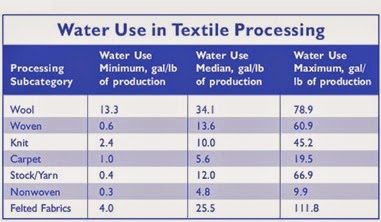
          Textile operations vary greatly in water consumption. Figure-1 summarizes the water consumption of various types of operations. Wool and felted fabrics processes are more water intensive than other processing subcategories such as wovens, knits, stock, and carpet.
          Figure-1
          Water use can vary widely between similar operations as well. For example, knit mills average 10 gallons of water per pound of production, yet water use ranges from a low of 2.5 gallons to a high of 45.2 gallons.

          Textile industry is a leading consumer of water and it ranks among ten top water consuming industries. Table-1 shows the approximate consumption of water for the processing of various textile fibres.

          Table-1 
          Water Consumption by Textile Industry in Various Processes

                Substrate …………………Water consumption (kg/kg of fabric)
          • Cotton …………………250-350 
          • Wool …………………..200-300 
          • Nylon ………………….125-150 
          • Rayon …………………125-150 
          • Polyester ………………100-200 
          • Acrylic …………………100-200 

          Cotton fibres require the largest amount of water for its preparation. In general, the water consumption in a process house is about three times the consumption of all other units put together (Table-2). The water consumption in the bleaching section is highest.

          Table-2 
          Water Consumption Pattern in Textile Mills

                 Process ……………………………Water consumption (% of total)
          • Bleaching, Finishing ……………38 
          • Dyeing ………………………16 
          • Printing ……………………….8 
          • Boiler House …………………14 
          • Humidification (spinning) ………6 
          • Humidification (weaving)……… 9 
          • Sanitary, Domestic etc……….. 9 

          The conventional preparatory processes of textiles namely, desizing, scouring, bleaching, and washing are highly water consuming operations and consequently energy-intensive (Table-3).

          Table-3 
          Consumption of Water and Energy in Kiers and J-Box Processes

          Process ……Consumption of water 1/kg……Consumption of steam kg/kg
                                                 (J-Box Processes)
          • Desizing …………………………3 …………………..….0.25 
          • Washing ……………………….20 …………………..…0.35 
          • Scouring ………………………2 ………………………..1.75 
          • Washing ………………………..20 …………………..…0.30 
          • Bleaching ………………………2 ……………………….1.00 
          • Washing ……………………….40 ……………………….0.60 
                    Total ……………………………87 ……………………..4.20 
                  
                   Conventional kier-boiling …100 ……………………….5.10 
           

          Friday, 25 April 2014

          Chemistry Behind Yellowing of Textiles- Causes and Preventive Measures

          Chemistry Behind Yellowing of Textiles- Causes and Preventive Measures

          K.Senthil Kumar
          Intertek India Pvt. Ltd, Bangalore, India
          Email: senthilkumar163@gmail.com
          Mamatha Kambam  
          USA 
           Email: mamatha.kambam@gmail.com


          ABSTRACT
          Yellowing is the discoloration of textiles developed during production, processing, usage& storage. It is one of the most common quality problems in natural and synthetic fibers. About 20% of textiles are finished in full white. Yellowing is mostly encountered in white and pastel colors, Even dark shades are also affected and it is not prominent. So it is necessary to know the chemistry behind, various causes and preventive measures of yellowing. In this article the various potential causes of yellowing like fiber ageing, yellowing due to gaseous pollutant in the atmosphere, chemical auxiliary used in processing and finishing, contaminant present in the storage materials & the preventive measures are studied.

          Why white garments tend to yellow?
          In general a substance appears to white when it reflects red, blue and green light. On usage due to fiber ageing and environmental factors the substance absorbs blue light and it reflects red and green light. By theory of light a substance appears to be white when it reflects red, blue and green light. If it absorbs blue light then it reflects red and green light. The combination of red and green gives yellow light. That’s why the white garments shows Yellowing.
          Yellowing of Textiles
          Causes of Yellowing:

          1. Fiber ageing
          Fiber ageing is one of the primary causes of yellowing. The environmental impact on the textile fibers leads to fiber ageing. The continuous exposure of sunlight leads to photo degradation of the textile fibers in particular natural fibers like cotton, viscose, linen etc. In the photo degradation process there is breakage of bond occurs within the polymeric structure of the fibers and leads to strength and color loss etc.. Usually natural fibers like cotton by its origin it is slight yellowish in color. On further photo oxidation it yellowness increase. Manmade fibers like nylon, spandex and polyester are more prone to yellowing.
          • We can avoid the fiber ageing by proper storing of fibers.
          • Avoid exposure to direct sunlight and high humidity.
          2. Environmental pollutants
          Yellowing issues due to the atmospheric pollutants play a vital role. The various environmental pollutants are ozone, NOX, SOX etc..

          2.1 Yellowing by ozone
          Ozone is a tri-atomic molecule of oxygen. It is a strong oxidizing agent.

          2.1.1 Ozone Formation
          Ozone is one of the primary pollutants which found naturally in atmosphere. In addition to this, ozone is produced by the combined action of sunlight, oxides of nitrogen and oxygen.
          Under the sun ultraviolet radiation of shorter wavelength (

          2.1.2 Yellowing of denims
          The ozone molecules present in the surface of the earth interact with the denim garments. Ozone oxidizes the Indigo dye into Isatin and Antranalic acid and the complex of the two products. Isatin is yellow in color, so indigo dyed blue garment turns to yellow.

          2.1.2.1 Factors affecting the yellowing of denims

          Unfixed dyes
          Indigo dyeing is ring dyeing technique in which dyes are not allowed to diffuse into yarn structure. On usage the dyes present at the surface of the yarn get abraded and gives faded look. The yellowing of Indigo dyes depends on the unfixed dye particles present on the surface of the yarn. The unfixed dyes are mainly due to back staining occurring during the washing process. Back staining is the re deposition of the loose dyes discharged in to the wash bath.
          • Unfixed dyes should be removed at the end of the dyeing process.
          • Prevent back staining during de sizing & washing process by using proper anti back staining agents.
          Humidity
          Yellowing of denim depend on the humidity of the garment in which it is present. Water film formation occurs at the surface of the fibers and causes swelling. The swelled fibers absorb ozone easily and results in yellowing.
          • Avoid storing the garment in humid condition.
          • Don’t leave the garment in wet condition for longer period.
          Anti ozone softeners
          For a short term protection we can go by antioxidants like sodium bisulfate and ethylene diamine etc.. These agents undergo decomposition process and protect Indigo dyes from yellowing. For a long term period we can use anti ozone softeners & these are amine based softeners.

          How Anti ozone softener works?
          The main steps involved are

          a. Film formation
          The anti ozone softener forms a film over fabric surface thus preventing the Indigo dye from reaction with atmospheric ozone.

          b. Self degradation
          The anti ozone film will react with atmospheric pollutants and undergoes self degradation process and breakdown in to its colorless compounds. Thus the anti ozone softener undergoes self scarification process in the prevention of indigo dyes from the oxidation.

          2.2 Oxides of nitrogen
          Oxides of nitrogen are one of the main causes of yellowing. In the combustion process when the temperature of air exceeds 538˚C, nitrogen and oxygen combine to form nitrogen oxide. These nitrogen oxides are released from automobiles, trucks and industrial equipments. These nitrogen oxides react with the residues present on the surface of the fabric. At higher concentration these oxides of nitrogen directly affect the nylon fiber.
          • Ware houses and factories should be properly ventilated to avoid the accumulation of oxides of nitrogen.
          • Avoid use of diesel trucks instead use electrical trucks in ware houses and storage areas.
          3. Transferred contaminants
          One of the main causes of yellowing of white and pastel shades is phenols. BHT (Butyl Hydroxyl Toluene) is an antioxidant used in polythene and polypropylene bags to prevent ageing of olefin. It is used in shoulder pads and interlining materials

          3.1 Mechanism of yellowing
          BHT undergo oxidation process in the presence of NOX to form quinone and nitrophenol. 2,6 di-tert butyl p-cresol undergoes nitration in the presence of NOX to form 2, 6 di-tert-4-nitrophenol.


          In the presence of nitration it forms quinone. These products are yellow in color. Even at the room temperature it can be transferred to the textile materials These kind of yellowing occur in the form of yellow streaks or patches while the garments are stored in poly bags in retail shops. This reaction is base catalyzed and takes place in slightly alkaline medium. These nitro phenols and quinines are colorless in acidic medium and become bright yellow in alkaline medium.

          It is found that polyamide fibers shows severe yellowing with BHT. This yellowing is reversible and it can be removed by acid scouring or washing with hot water and methanol.
          • It can be prevented by avoiding the usage of BHT poly bags for storage purpose. 
          • The pH of the final stage of the garment should be slightly acidic to neutral (5.5 to 6.5). Neutralize with non volatile organic acid (Citric and oxalic acid) to achieve core neutralization. Avoid using volatile acid for neutralization process because only ring neutralization can be achieved. 
          • Avoid the accumulation of exhaust gases to control the reaction between BHT and nitrogen oxides. 
          • To avoid the reaction between BHT and nitrogen oxides we can use Anti phenolic yellowing agent. 
          • These agents blocks the reactive sites of BHT ,thus the reaction between the BHT & Atmospheric nitrogen oxides are prevented.

          4. Chemical additives
          By improper use of chemical additives during processing and finishing like softeners, OBA and salts leads to yellowing.

          a. Softener
          Softeners are used to impart soft handle to the fabric. Among softeners most commonly used is the cationic and silicone softeners. These are amine based softeners (N-H) and reacts with free chlorine present in the commercial detergents containing chlorine bleaches and also with municipal water containing chlorine as a disinfectant. The chlorine reacts with these amines to form chloramines (yellow in color). So it imparts yellow color to textile garments.

          In addition these amines undergo oxidation process at temperature over 140˚C to form oxides of nitrogen. These oxides are yellow in color at lower concentrations.
          • Use softeners with low amine value.
          • Wash with detergents containing non chlorine bleaches and enzymes.
          b. Optical Brightening Agents
          OBA is used to enhance the whiteness of the fabric. The unsaturated structure of OBA absorbs uv light and violet light at 340-370nm and it re-emits the absorbed uv light (short wavelength) in to visible blue light (longer wavelength) at 420-470nm. The emitted blue light changes the hue of the yellowness in the fabric to whiter. These unsaturations are very sensitive to sunlight and loss its ability to work & leads to yellowing
          • OBA used for cellulosic fibers not stable at low pH so it leads to yellowing.
          • Unfavorable conditions like excessive heat and high humidity leads to oxidation of OBA and it loses its whiteness.
          • Over usage of OBA beyond the saturation limits leads to yellowing and it can be controlled by stripping.
          • Proper selection of OBA to avoid ionic interactions of anionic brightener with cationic finishes leads to deterioration of brightener.
          5. Conclusion
          From the above study it can be concluded that yellowing of textiles is mainly due to fiber ageing, atmospheric pollutants, chemical additives and storage contaminants. The below precautionary measures should be taken at each stage of the garment production until it reaches the final customer.
          • pH of the garments should be slightly acidic to neutral.
          • Avoid storing in place contain atmospheric pollutants like NOX and SOX.
          • Avoid use of poly bags containing BHT.
          • Proper selection and usage of OBA.
          6. References
          1. “Yellowing of white fabric and garments” by Dr. Naresh M Saraf and Deepak V. Alat, International dyer, page no: 23-25 
          2. “Yellowing of textiles” by Rajesh koul at http://articles.fibre2fashion.com
          3. “Jack ‘n’ Jill and their Jaded Jeans” by Dr. Naresh M Saraf and Deepak V. Alat, International dyer, page no: 28-30 
          4. “Yellowing of textiles on storage” by David T Parkes at http://articles.fibre2fashion.com
          5. Denim garment processing by Dr. Ravichandran.L, Fabric Care